
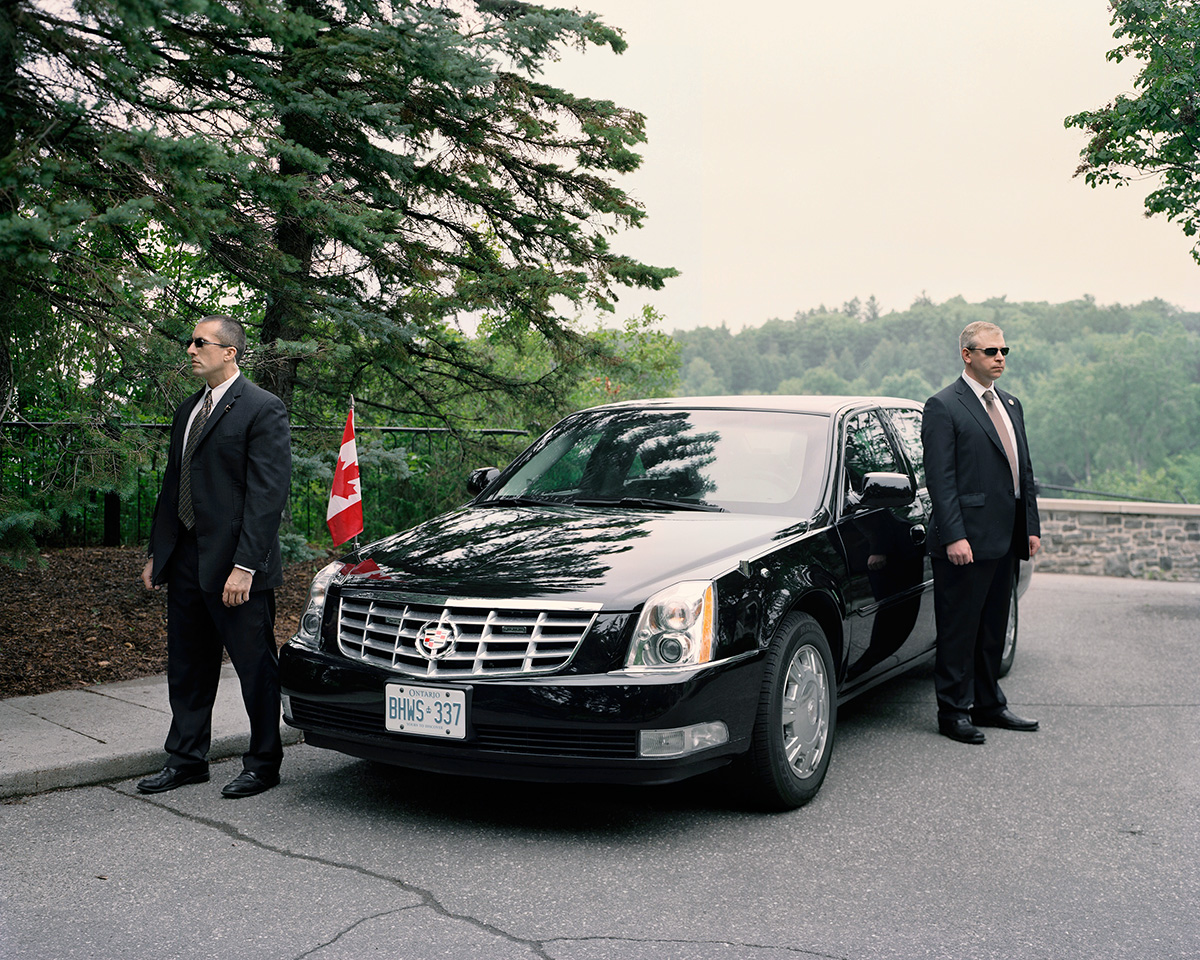
Tony Fouhse | Prime Minister’s Limo, 2012. | From the series Official Ottawa.
1. You’ve been working as a commercial, editorial and fine art photographer shooting on film – especially large format film – for over 30 years and are still adept at it today, as witnessed in many of your personal work (Los Angeles, Beside The Passaic, and of course Roids): have your film-based artistic practices changed since you started, and if yes how?
First of all, I want to make clear that most of my commercial work and some of my editorial gigs are shot with digital cameras, and have been for about ten years. Having said that, these days I’m shooting more and more editorial work on medium and large format film . . .some shoots it’s just me and my Linhof and 2 film holders. Shooting paid gigs and only having 4 shots certainly makes you feel alive.
But to answer the question: yes. Back in the day I was shooting primarily B+W because I don’t know how to make color prints in a darkroom. But I’m a pretty good B+W printer so that’s what I’d do, shoot Plus-X, process it and make prints.
Once it became possible to shoot color film, scan it and do the rest digitally I totally switched over to shooting color. That’s a pretty big change, there was lots of trial and error (mostly error) and I’m still learning.
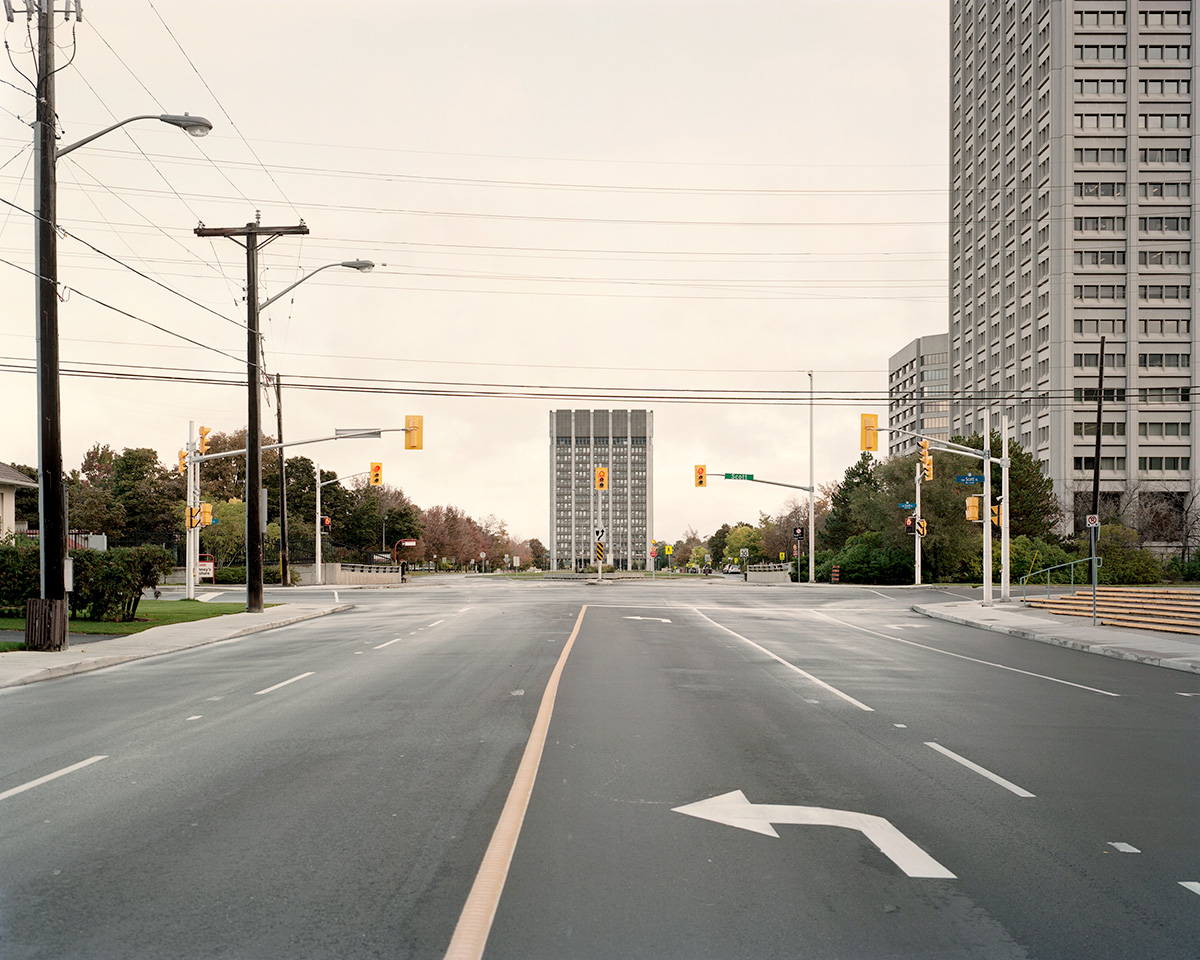
Tony Fouhse | Government Buildings, 2013. | From the series Official Ottawa.
2. For most people, the recurring question on the topic of the film medium is why? Why photographing on film in 2013? As an experienced artist photographing both on film and digitally, what do you think (besides why not ;)?
For me there are two main reasons to shoot film. The first is that shooting film slows you down, forces you to make more hard decisions on the ground, while you are actually there and, subsequently, you become “there” in a different way.
The second reason is because film cameras create a different juju between the photographer and the subject (I’m primarily a portrait photographer). This has to do with working more slowly and deliberately which creates a feeling of commitment that affects both the photographer and the subject. And commitment is a prime ingredient in my working method.
(Of course, having said that, my latest project only involves portraiture tangentially. See below . . .)

Tony Fouhse | Charles Bordeleau, Chief of Police, 2013. | From the series Official Ottawa.
3. You live in Ottawa, Canada and often travel the entire country (and abroad) for commissioned and personal projects: how is the film photography industry doing now in Ottawa and Canada in general? Do you see a viable future for it anywhere?
I know a number of documentary photographers who are beginning to switch back to film, if they had even given it up in the first place. I believe they are doing this for the reasons I outlined above. Plus, larger format cameras (usually) make the photographer’s presence more obvious and this goes some way towards helping to find and define what I consider to be a more honest approach to how photographers fit into this world. I don’t believe in objectivity, so anything the recorder can do to assert that they were there goes some way to showing that it’s all subjective.
Here in Ottawa there is The School of the Photographic Arts: Ottawa (spao.ca), where almost all the students work with film and, often, with old and/or alternate processes (paper negs, tintype, wetplates and so on). There seems to be an appetite for this.
In terms of “the future” . . .one thing I’ve learned is that you never know what is going to happen. Each day goes by, much like the one before it, but just different enough to allow for evolution which, by its nature, is a slow process. And then, every so often, something seismic happens and a lot of stuff changes quickly.
4. FOTOFILMIC is dedicated to promoting the new generations of photographers attached to film today: what essential advice or recommendation would you have for them?
I’d say that a camera is just a tool and that it’s important to use the right tool for what it is you want to achieve, whether it be film or digital, large or small. The tool you choose has an effect on the outcome and it’s the job of the photographer (if you ask me) to affect the outcome in order to show their point of view.
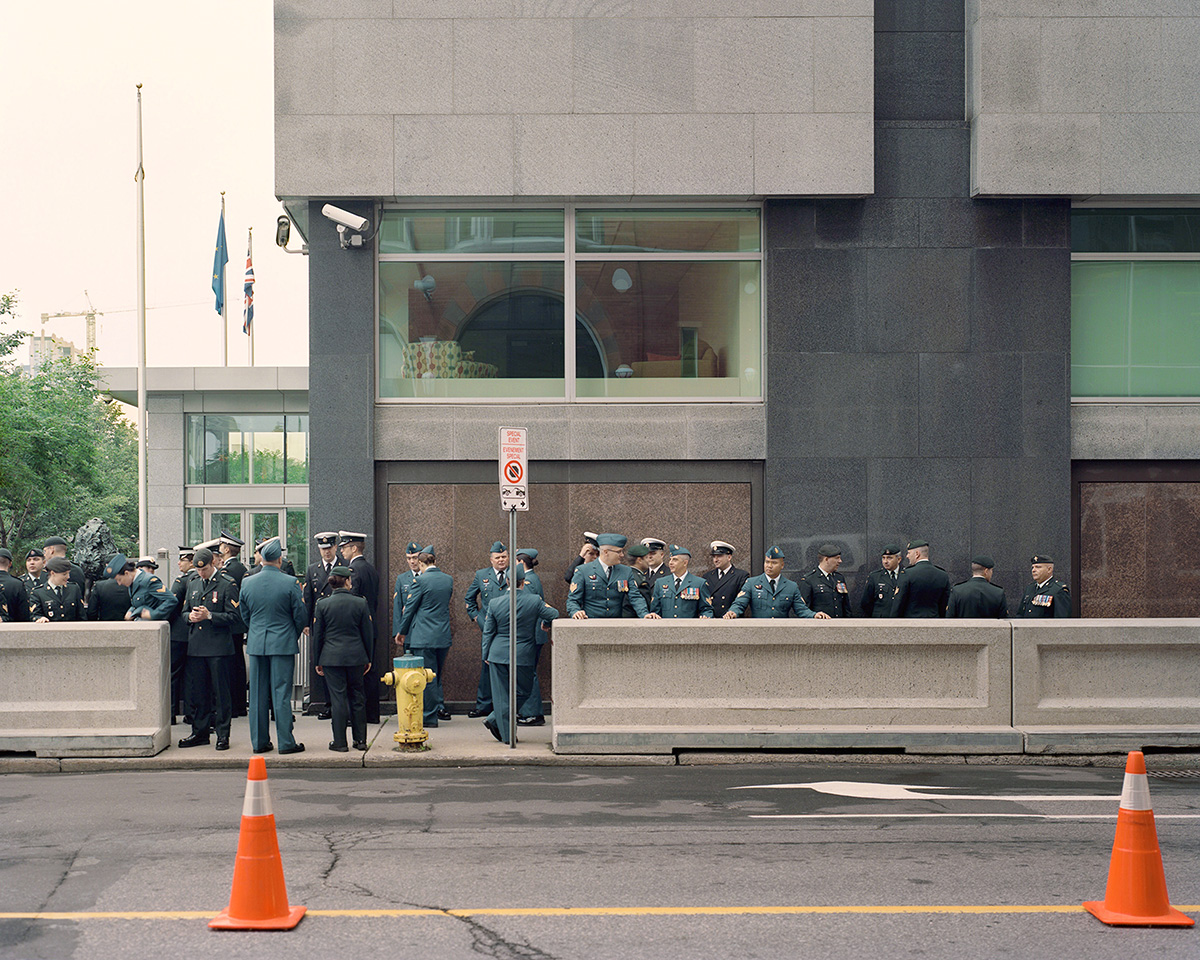
Tony Fouhse | Special Event, 2013. | From the series Official Ottawa.
5. What have you been up to recently? Any recent achievements, projects, news?
After immersing myself in Ottawa’s drug scene for a number of years to produce two bodies of work, “USER” (shot on film) and “Live Through This” (digital), I decided to shift gears. These days I’m considering the opposite end of the spectrum with a series of photographs that looks at the federal presence in this (capital) city. “Official Ottawa”.
Many Canadians, if they think about it at all, think about Ottawa in media-fed images: it’s natural beauty, the Parliament Buildings, and all the clichés of staged politics and power.
This new series of photographs looks at Ottawa from a different perspective. Rather than considering the hype and the myth and the fairytale that those in power create, manage and perpetuate, this work strips the capital down to show the bones of the thing.
“Official Ottawa” looks, in a plain and simple way, at the official infrastructure, institutions and people that shape and inhabit this city. I’m shooting architecture, portraits and found tableaux.
6. If anything was possible, what would be your next ultimate project photography-wise (or else)?
I never think that far ahead. Usually I just go about my business and practice and wait for something to grab me by the throat.
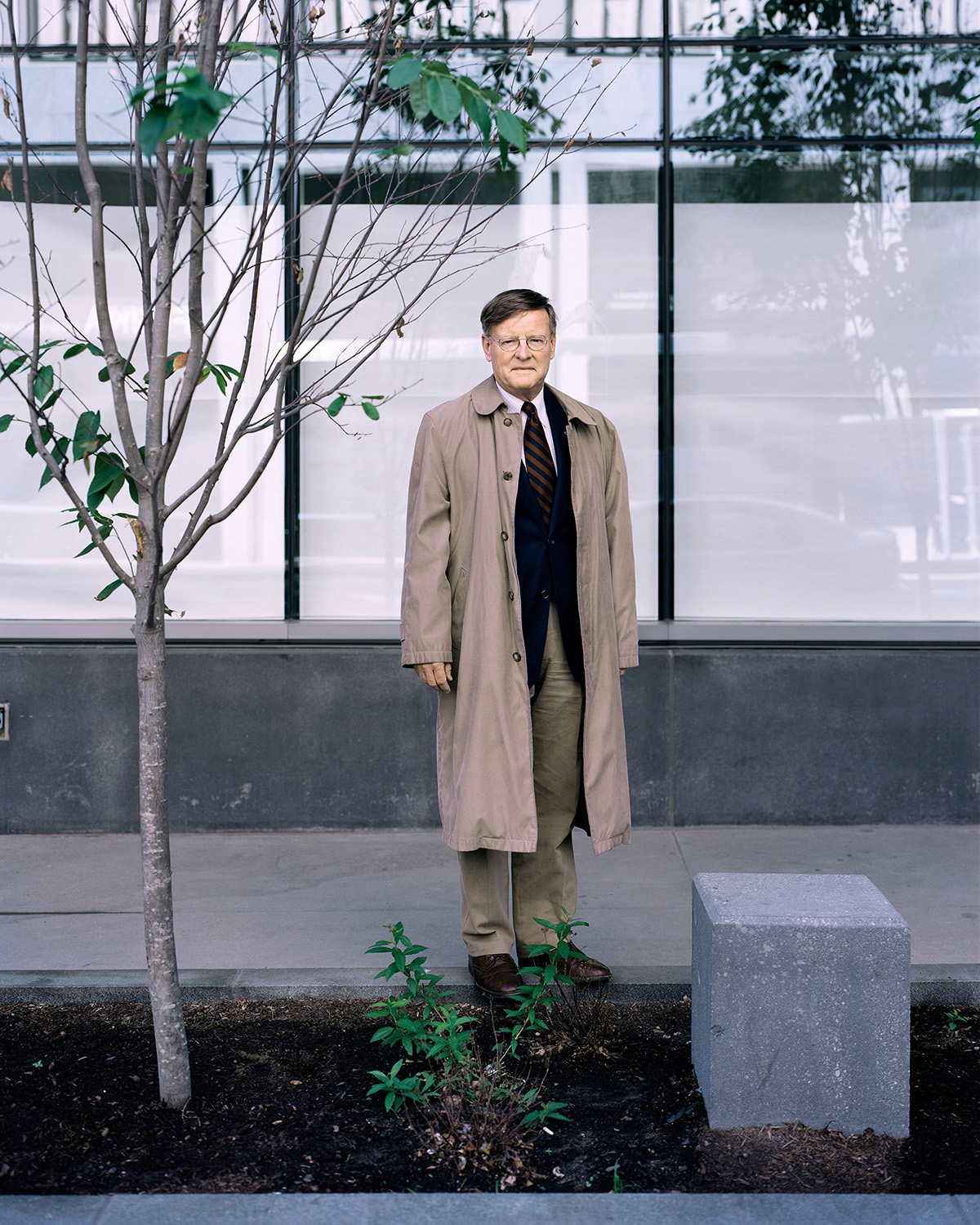
Tony Fouhse | Jeffrey Simpson, National Affairs Columnist, 2012. | From the series Official Ottawa.
© All photos by Tony Fouhse
Tony Fouhse’s website
________________
FotoFilmic’s new FILM TALKS series is all about sharing experienced views, artistic endeavors, industry outlooks and how to reshape the contemporary practices at the center of the film photography medium today. FILM TALKS invite advanced artists, independent publishers, photo editors and art dealers, as well as the broad creative crowd of visual arts to engage in insightful dialogues with FotoFilmic about film photography in all aspects.